
.png)
601-588-2195
_HEIC.png)
_HEIC.png)
_HEIC.png)

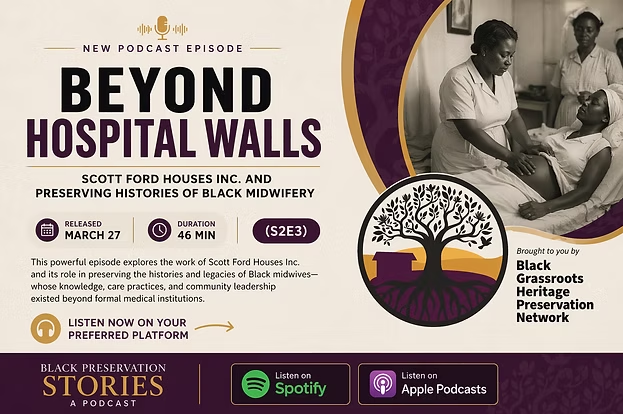
Midwifery and the Scott Ford Houses
The Scott Ford Houses tell a story about Black women’s care work as survival, leadership, and knowledge in Mississippi. They center the lives of Mary Green Scott and her daughter Virginia Scott Ford, whose labor reflects how Black women created stability and health systems in a segregated society.
Mary Green Scott, born enslaved, built her independence through domestic work and laundry, which were jobs available to Black women after Emancipation but rarely compensated fairly. Through years of saving, she purchased land on East Cohea Street and, between 1891 and 1892, built two houses: one for herself and one for her daughter. For a Black woman in Mississippi, owning property in her own name was exceptional. It provided security, status, and the ability to pass something tangible to the next generation.
That foundation made possible Virginia Scott Ford’s work as a midwife. In the early twentieth century, most Black women in Mississippi gave birth at home, attended by community midwives rather than physicians. Hospitals were segregated, distant, or unwelcoming, and doctors were often unaffordable. Midwives filled this gap. They learned through apprenticeship: watching older women, practicing under supervision, and carrying knowledge passed down across generations.
Midwives did far more than deliver babies. They advised women during pregnancy, stayed with them during labor, helped mothers recover, and returned to check on infants. They were often called in the middle of the night and worked with few resources. Payment was modest and sometimes symbolic. What sustained their work was trust. A midwife’s authority came not from a degree, but from the community’s confidence in her care.
Virginia Scott Ford practiced midwifery from her home and throughout Jackson. Family memory suggests that the Scott Ford Houses themselves served as places of birth and recovery, making the site not just a residence but a center of community health. Her husband, John Ford, supported her work by transporting her to clients, reminding us that midwifery was often supported by family networks behind the scenes.
This history might have been lost were it not for Dr. Alferdteen Brown Harrison, a historian and cultural leader whose career has focused on preserving African American history in Mississippi. As founder of the Smith Robertson Museum and Cultural Center and former director of the Margaret Walker Alexander National Research Center at Jackson State University, Dr. Harrison helped recognize the Scott Ford Houses as one of the few surviving sites connected to Black midwifery and worked to ensure their preservation.
Today, the Scott Ford Houses help visitors understand midwifery not as folklore, but as a community-based health system that sustained Black families for generations. At a time when Mississippi continues to face severe maternal health disparities, the legacy of women like Mary Green Scott and Virginia Scott Ford offers insight into how care rooted in trust, continuity, and community once saved lives, and why that history still matters.